
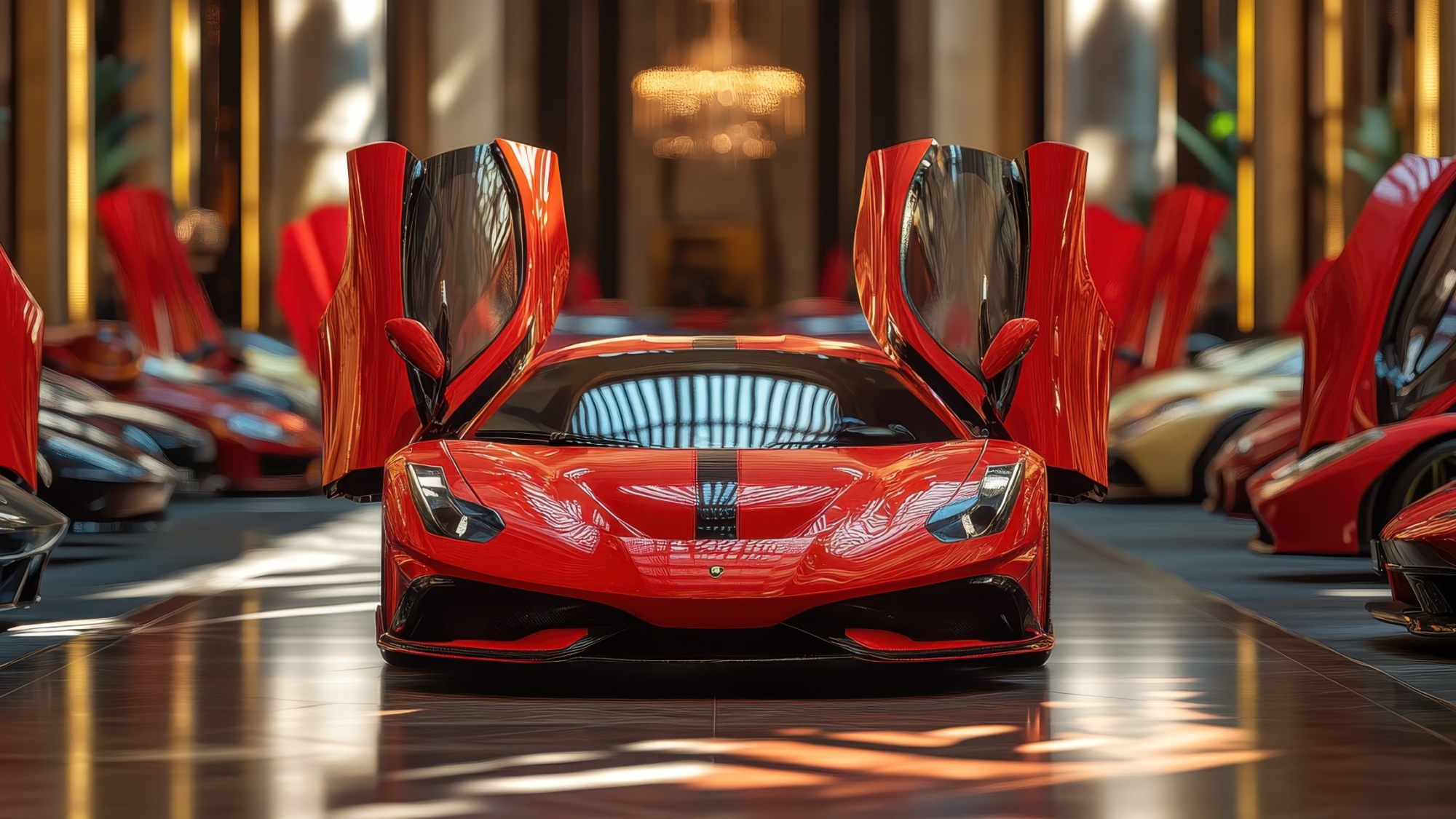
Few car brands are instantly recognisable, but Ferrari is certainly one of them. The company’s story is divided between two closely linked yet largely independent operations: the racing team and the road car business.
The racing team came first, created by Enzo Ferrari in 1929 to compete with Alfa Romeo cars across Europe. The road car operation followed nearly two decades later, initially as a way to fund Enzo’s racing ambitions. Over nearly a century, Ferrari has become the most revered name in motorsport and one of the most exclusive sports car manufacturers in the world. Its fans, known as the tifosi, treat the brand almost like a religion.
The Early Years
Enzo Ferrari began racing in 1919 and eventually became Alfa Romeo’s team manager. In 1929, he founded Scuderia Ferrari, racing Alfa Romeos under his own team. After a brief return to Alfa and the interruption of World War II, Enzo set out to create his own racing cars. To fund this, he sold vehicles to wealthy amateur drivers, which naturally evolved into selling road cars to similarly affluent customers. Ferrari was officially established in 1947.
Early Ferraris were essentially detuned racing cars, typically two-seaters with V12 engines and coachbuilt bodies. Over time, the company formed a long-lasting partnership with design firm Pininfarina, lasting six decades until styling was brought in-house in 2012. By the 1950s, Ferrari road cars were highly desirable, becoming status symbols for celebrities and enthusiasts alike.
Growth and Partnerships
By 1960, managing both the racing team and road car business became demanding. Enzo considered partnerships, including talks with Ford, but ultimately joined with Fiat in 1969, which helped launch key models like the Dino 206 and Daytona.
In the 1980s, Ferrari introduced its first supercar, the 288 GTO, followed by the F40, Enzo’s last car before his death in 1988. Fiat’s stake eventually increased, stabilising the company and allowing the road car division to flourish. Limited-edition models like the F50, Enzo Ferrari, LaFerrari, and the F80 further cemented Ferrari’s reputation.
In 2016, Ferrari became independent from Fiat, producing fewer than 14,000 cars annually while remaining one of the most valuable car manufacturers in the world.
Motorsport Success
Ferrari remains defined by racing. The team has won 15 Formula 1 World Drivers’ Championships, 16 Constructors’ Championships, and 12 Le Mans 24 Hours overall victories, along with thousands of other race wins in GT categories worldwide.
Current Model Range
The entry-level Ferrari is the Roma, priced from around £178,000 for the coupe, with the convertible version slightly higher. The Roma mixes performance with a surprising degree of practicality for a Ferrari and is set to be replaced by the Amalfi, which builds on the same chassis with revised styling and technical upgrades.
The Roma’s larger sibling, the 12Cilindri, launched in 2024 with a V12 engine, is priced from £340,000. It continues the tradition of large GT models, praised for performance and driving dynamics.
Ferrari has also embraced trends in luxury cars by introducing the Purosangue, a five-door model described as a ‘dynamic coupe’ rather than a conventional SUV, powered by a 6.5-litre V12 engine.
Electrification and Hybrid Models
Ferrari will launch its first fully electric car in 2026. In the meantime, plug-in hybrid models have entered the range. The Ferrari 296, a mid-engined 3.0-litre V6 plug-in hybrid, is offered as a GTB coupe or GTS targa. Its larger sibling, the SF90 Stradale, features a more powerful hybrid system and is about to be replaced by the upgraded 849 Testarossa.
Exclusivity and Ownership
Ferrari maintains its exclusive image by limiting production and carefully selecting customers. Modifications are allowed only through the factory, and owners who do not treat their cars respectfully can be blacklisted. Limited-run models are often reserved for customers who have previously owned Ferraris.
Prices for Ferraris start at around £180,000, quickly rising to half a million for flagship models, with special editions costing even more. Despite high prices, demand always exceeds supply, and cars sell out rapidly.
Iconic Branding
The prancing horse logo has a unique origin. It was originally used by Italian WWI flying ace Count Francesco Baracca. At his mother’s request, Enzo Ferrari adopted the emblem on his cars for luck, creating one of the most recognizable symbols in automotive history.
Finding a Ferrari
Ferrari is not sold through standard dealerships. Showrooms are limited, carefully designed, and operate more like boutiques than traditional car dealerships. Buying a Ferrari involves more than just purchasing a car; it’s about joining a legacy of performance, prestige, and exclusivity.